What Size Dehumidifier Do You Need for a Basement?
Size chart: pint capacity by square footage and dampness
Most basements need a 50-pint dehumidifier (DOE 2020). A small, slightly damp basement under 500 sq ft can run on 20 to 35 pints. A large or wet basement over 1,500 sq ft needs 70 pints. Find your exact size in the chart below, sized the same way this site's calculator sizes it: base DOE pint matrix times a basement modifier of 1.3x for finished spaces and 1.5x for unfinished ones.
50-pint
20 to 35-pint
70-pint
Finished Basement Size Chart
Drywall, flooring, and a vapor barrier hold less ambient moisture. Use this table for a finished basement at a standard ceiling height in a moderate climate.
| Basement size | Damp | Very damp | Wet |
|---|---|---|---|
| Up to 500 sq ft | 20-pint | 35-pint | 35-pint |
| 500 to 800 sq ft | 35-pint | 35-pint | 50-pint |
| 800 to 1,200 sq ft | 35-pint | 50-pint | 50-pint |
| 1,200 to 1,500 sq ft | 50-pint | 50-pint | 70-pint |
| 1,500 to 2,000 sq ft | 50-pint | 70-pint | 70-pint |
Unfinished Basement Size Chart
Exposed concrete, a bare slab, and no vapor barrier release more moisture, so an unfinished basement needs more capacity than a finished one of the same square footage.
| Basement size | Damp | Very damp | Wet |
|---|---|---|---|
| Up to 500 sq ft | 35-pint | 35-pint | 35-pint |
| 500 to 800 sq ft | 35-pint | 50-pint | 50-pint |
| 800 to 1,200 sq ft | 50-pint | 70-pint | 70-pint |
| 1,200 to 1,500 sq ft | 50-pint | 70-pint | 70-pint |
| 1,500 to 2,000 sq ft | 70-pint | 70-pint | 70-pint |
For a result tuned to your exact ceiling height, climate zone, and moisture sources like a sump pump or laundry, run the sizing calculator. It applies the same DOE math used to build these tables.
Get your exact basement size
The chart covers common cases. The calculator factors in ceiling height, climate zone, and extra moisture sources to return a precise pint figure and matching product picks for your basement.
Use the Free Sizing CalculatorHow to Size a Dehumidifier for a Basement in 4 Steps
- Measure the square footage. Length times width of the basement floor. For an L-shaped basement, measure each rectangle and add them. Round up, not down.
- Rate the dampness. Damp means a musty smell and clammy air with no visible water. Very damp means condensation on pipes, walls, or windows. Wet means seepage, damp spots, or standing water after rain.
- Note finished or unfinished. Bare concrete and slab release more moisture than drywall and flooring, so an unfinished basement uses the second chart and usually lands one pint tier higher.
- Read the pint tier off the chart, then adjust up one tier if the ceiling is over 9 ft, the climate is humid, or there is a sump pit, laundry, or shower down there. When in doubt, go up a tier: an oversized unit cycles less and lasts longer, an undersized one runs nonstop and never gets ahead.
How These Numbers Are Set
The chart is not a guess. It uses the U.S. Department of Energy 2020 sizing methodology: a base pint requirement from square footage and dampness, then a room adjustment. Below-grade space holds moisture that an equivalent above-ground room does not, so basements get a multiplier. A finished basement uses 1.3x. An unfinished basement or crawl space uses 1.5x because exposed concrete and soil vapor add load. The resulting daily pint figure maps to a product tier: 22 pints per day or less is a 20-pint unit, up to 38 is a 35-pint, up to 55 is a 50-pint, and above that is a 70-pint or commercial unit. Remember the DOE changed its test conditions in 2020, so a unit once labeled 70-pint is now rated 50-pint. Same machine, different number on the box.
Worked Example: A 1,000 Sq Ft Finished Basement
Take a 1,000 sq ft finished basement that smells musty in summer and has light condensation on the cold-water pipes, which puts it in the very damp column. The DOE base requirement for that square footage and dampness is about 38 pints per day. Apply the 1.3x finished basement modifier and you get roughly 49 pints per day. That lands in the 50-pint tier. If the same basement were unfinished with exposed concrete, the 1.5x modifier pushes it to about 57 pints per day, which moves it into the 70-pint tier. This is exactly why the two charts above differ for the same square footage.
Pump, Gravity Drain, or Bucket for a Basement
Sizing decides capacity. Drainage decides whether the unit runs unattended. A basement dehumidifier sized at 50 pints can pull multiple gallons a day, so emptying a bucket by hand is not realistic for long. If your basement has a floor drain that sits lower than the unit, a gravity drain hose is the simplest setup: attach the hose and let water flow downhill, no pump needed. Most basements do not have a conveniently placed floor drain. In that case a built-in pump matters. It pushes condensate up to 16 feet vertically to a sink, utility drain, or out a window, so the unit runs continuously without you touching it. Plan on continuous drainage for any basement unit. A pump model costs $20 to $40 more than a gravity-only unit and is almost always worth it for a basement. For a step-by-step walkthrough of each option, see the drainage setup guide.
Recommended Basement Dehumidifiers by Size Tier
Once the chart gives you a pint tier, here is a solid pick for each. Every product uses the current DOE 2020 rating.
50-Pint — Most Basements (up to ~1,500 sq ft)
MOST COMMON BASEMENT SIZE

Midea Cube 50-Pint Dehumidifier
Midea
★3.5·327 ratings
Fastest moisture removal in its class, quietest 50-pint unit available, and a 4.2-gallon tank that lasts days between empties. This is the unit most people should buy.
- + 3x larger tank than competitors (4.2 gal)
- + Quietest 50-pint unit (~47 dB)
- + Wi-Fi with Alexa and Google support
- + Compact cube design saves floor space
- + Gravity drain hose included
- - No built-in pump
- - App can be buggy on first setup

GE 50-Pint with Pump
GE
★3.3·107 ratings
The built-in pump pushes water up to 16 feet to a sink, window, or any drain. Set it and forget it. If your basement has no floor drain, this is the one.
- + Built-in pump drains up to 16 ft vertically
- + True set-and-forget operation
- + Sturdy, well-built construction
- + Easy-to-read display
- - No Wi-Fi or smart features
- - Louder than the Midea Cube (~52 dB)
- - Smaller tank (1.8 gal) if not using pump
70-Pint & Commercial — Large, Unfinished, or Wet Basements
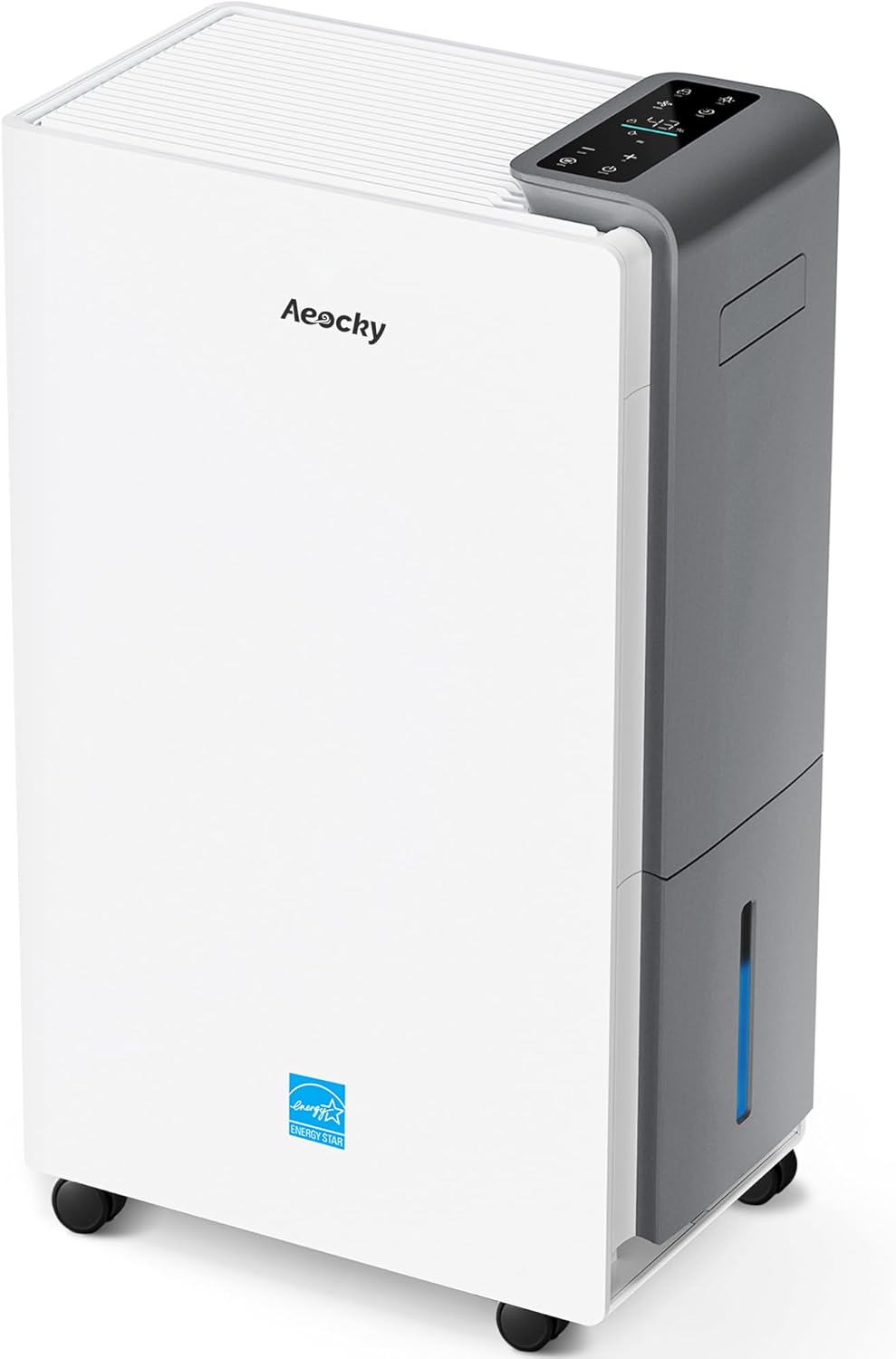
AEOCKY 80-Pint
AEOCKY
★4.5·7,256 ratings
Highest capacity in this tier. Built-in pump is a bonus at this price point. A strong pick for very large or very wet basements.
- + 80-pint capacity (highest available)
- + Built-in pump included
- + Wi-Fi connectivity
- + Great price for the capacity
- - Lesser-known brand
- - Long-term reliability unknown
- - Standard 1.9 gal tank
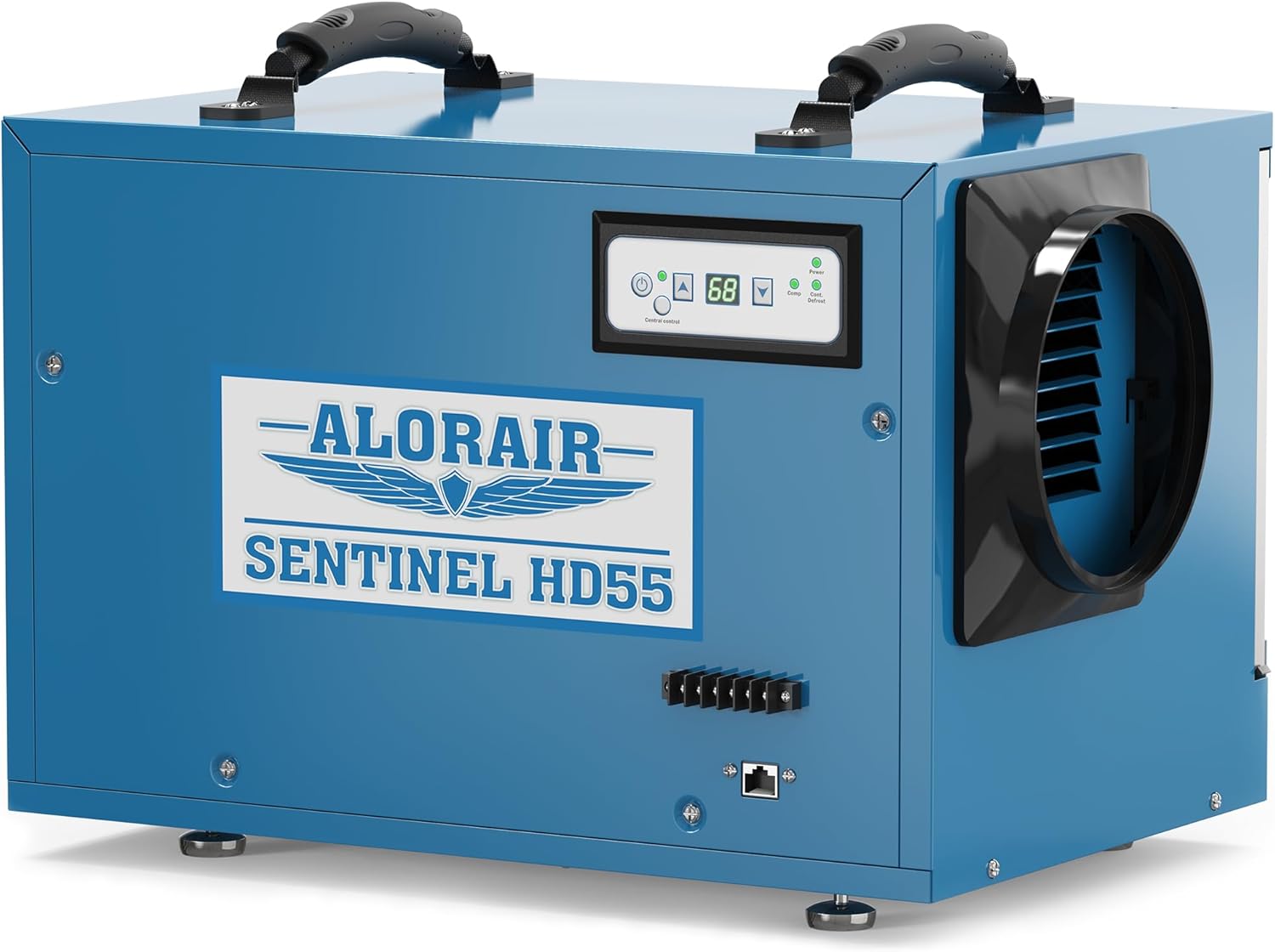
AlorAir Sentinel HD55
AlorAir
★4.2·1,228 ratings
Purpose-built for crawl spaces and harsh environments. Operates down to 36°F, metal construction, continuous drain only. This is what restoration professionals use. 5-year warranty.
- + Works down to 36°F (most units stop at 41°F)
- + Metal construction survives harsh environments
- + Continuous drain only (no bucket to empty)
- + 5-year warranty
- + Auto-defrost for cold environments
- - Expensive (~$450, priciest unit here)
- - No portable tank option
- - No smart features
- - Overkill for standard rooms
35-Pint — Small Finished Basements (under ~800 sq ft)

VEAGASO 34-Pint
VEAGASO
★4.5·3,074 ratings
The highest-rated unit in the 34-pint class. Covers 2,500 sq ft, runs at 40 dB or less in low and sleep mode (quiet enough for a bedroom), and includes a drain hose for continuous draining out of the box.
- + Highest rating in its class (4.5 stars)
- + 40 dB or less in low/sleep mode
- + Drain hose included for continuous draining
- + Auto defrost and 24-hour timer
- - Small 0.53 gal tank needs frequent emptying
- - No Wi-Fi or smart features
20-Pint — Tiny, Slightly Damp Basements (under ~500 sq ft)

Midea Cube 20 Pint
Midea
★4·2,548 ratings
The 3x larger tank means you empty it once every few days instead of daily. Wi-Fi control lets you monitor from your phone. Quiet enough for a bedroom.
- + 3x larger tank than competitors (3.2 gal)
- + Wi-Fi with Alexa and Google
- + Quiet enough for bedrooms (~45 dB)
- + Compact cube design
- + Gravity drain hose included
- - Higher price than basic 20-pint units
- - Cube shape takes more floor space
For the full set of basement picks with pump versus gravity drain trade-offs, see the best basement dehumidifier guide.
Frequently Asked Questions
What size dehumidifier do I need for a basement?
Most basements need a 50-pint dehumidifier (DOE 2020 rating). Use 20 to 35 pints for a small, slightly damp finished basement under 500 sq ft, 50 pints for the typical 800 to 1,500 sq ft basement, and 70 pints for anything over 1,500 sq ft, unfinished with exposed concrete, or wet. The charts above give the exact tier for your square footage, dampness, and finish.
How do I size a dehumidifier for a basement?
Measure the floor area in square feet, rate the dampness as damp, very damp, or wet, note whether the basement is finished or unfinished, and read the pint tier from the matching chart. Move up one tier for ceilings over 9 ft, a humid climate, or extra moisture sources like a sump pit or laundry. If the result is borderline, choose the larger unit.
What size dehumidifier do I need for a 1,000 sq ft basement?
A 1,000 sq ft finished basement that is moderately damp needs a 50-pint dehumidifier (DOE 2020 rating). If it is only slightly damp, a 35-pint unit covers it. Unfinished basements of the same size release more moisture from exposed concrete and soil, so plan on 50 pints when damp and 70 pints when very damp or wet. These numbers come from the same sizing logic the calculator on this site uses: the base DOE pint matrix multiplied by a 1.3x modifier for finished basements and 1.5x for unfinished ones.
What size dehumidifier for a 500 sq ft basement?
A 500 sq ft finished basement that is slightly damp needs a 20-pint dehumidifier. Once it is very damp or wet, step up to 35 pints. Unfinished basements of that size start at 35 pints because bare concrete and soil add moisture load that finished drywall and flooring do not.
Is a 50-pint dehumidifier enough for a basement?
A 50-pint dehumidifier (DOE 2020) handles most finished basements up to about 1,500 sq ft with moderate dampness, and damp basements up to 1,200 sq ft. It is the most common basement size for a reason. You only need to move up to a 70-pint unit for very large basements over 1,500 sq ft, unfinished spaces with exposed concrete, or basements with active water intrusion.
What does 'damp' vs 'very damp' vs 'wet' actually mean?
Damp: the space smells musty in summer and feels clammy, but there is no visible water. Very damp: you see condensation on pipes, cold walls, or windows, and the musty smell is persistent year-round. Wet: there is visible water seepage, damp spots on the floor or walls, or standing water after rain. Each step up roughly adds one capacity tier for the same square footage.
Do I need a bigger dehumidifier for an unfinished basement?
Yes. An unfinished basement with exposed concrete walls, a bare slab, and no vapor barrier releases noticeably more moisture than a finished basement of the same size. The sizing chart on this page applies a 1.5x modifier for unfinished spaces versus 1.3x for finished ones, which usually moves you up one pint tier.
Does basement ceiling height change the size I need?
It can. A standard 7 to 8 ft basement ceiling uses the chart values as listed. Tall ceilings above 9 ft hold more air volume and push capacity up by roughly 15 percent, which can move a borderline case into the next tier. The calculator on this site lets you set ceiling height for an exact figure.
Should a basement dehumidifier have a pump?
If your basement lacks a floor drain within hose reach, yes. A built-in pump pushes condensate up to 16 feet vertically to a sink, utility drain, or window, so it runs unattended. If there is a floor drain lower than the unit, a gravity drain hose works without a pump. For set-and-forget basement operation, a pump is worth the extra $20 to $40.
Keep Sizing
Dehumidifier Sizing Calculator
Exact pint capacity for your room, dampness, and climate.
Best Dehumidifier for a Basement
Top picks with pumps and continuous drain for basements.
How Many Dehumidifiers?
Multi-room or multi-floor basements may need more than one unit.
Drainage Setup Guide
Pump, gravity drain, or bucket: pick the right basement setup.